
FAQs
- General Fund: Covers day-to-day services, operations, and staffing.
- Capital Funds: Pay for major infrastructure and construction projects using dedicated funding sources such as voter-approved taxes, grants, or development-related revenues (like the Quality of Life and Food Taxes). These funds often have strict rules governing what they can be used for.
- Enterprise Funds: Supports services like Water, Sewer and Stormwater that are primarily funded by customer rates and fees, like those paid in your utility bills.
- Category A: 25% budget reduction target
- Category B: 17% budget reduction target
- Category C: 4% budget reduction target
- Category A: 25% budget reduction target
- Category B: 17% budget reduction target
- Category C: 4% budget reduction target
Key Terms
Capital Fund: Funds set for major one-time investments such as buildings, streets, infrastructure, and large equipment.
Enterprise Fund: A fund used for services that are primarily supported by fees paid by users, such as utilities.
General Fund: The City's primary operating fund, used for many core municipal services and day-to-day expenses.
One-time Funds: Money that is available temporarily, such as reserves, a temporary transfer, or other non-recurring resources.
Reserves: Savings set aside to help the City manage emergencies, cash flow needs, or unexpected financial changes.
Restricted Funds: Money that can only be used for specific legal, voter-approved, contractual, or policy-defined purposes.
Structural Deficit: An ongoing gap between recurring revenue and operating expenses.
What is the General Fund?
The General Fund is the City's primary operating fund. Think of it as the City's main checking account. Revenues from sales taxes, property taxes, recreation fees and the like come in and then the City uses that fund to pay for day-to-day services. Those services include public safety, street maintenance, parks and recreation, and community services.
Most City employees are funded through the General Fund unless their positions are supported by another dedicated funding source.
What is the difference between the General Fund, Capital Funds, and Enterprise Funds?
In simple terms:
Why can't the City just move money from one fund to another?
Many City revenues are legally restricted for specific purposes. For example, some funding sources may only be used for capital infrastructure projects, utility operations, or other voter-approved purposes.
Because of these restrictions, money that funds specific purposes often cannot legally be moved to pay for general staff salaries, benefits and other General Fund operating expenses.
What is a structural deficit?
A structural deficit happens when ongoing expenses are projected to grow faster than ongoing revenues. The City of Greeley has identified a structural deficit in the General Fund that must be addressed through the 2027 budget process.
Who decides how the budget is built and approved?
Per the City's charter, the City Manager and staff develop a recommended budget based on multiple factors. These include City Council direction, financial forecasts and community priorities. The process starts with department directors preparing budget recommendations within established spending targets.
Through the budget process, City Council receives updates, provides feedback, and ultimately adopts the annual budget. Residents can also follow the process and provide input during public meetings.
Ultimately the budget must be adopted by City Council in a formal process that includes two meetings. One public hearing and then a formal adoption. This usually occurs in October of each year.
Is the budget targeting one department over others?
No. Every City department is working to tackle the structural deficit. However, not all departments have the same budget cut target.
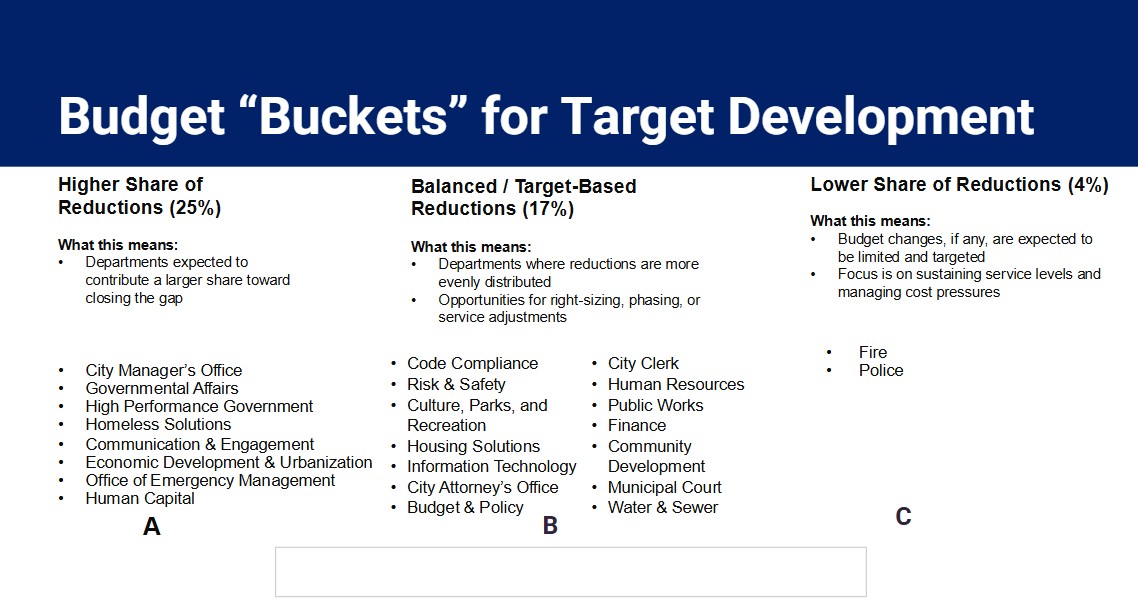
During a City Council budget retreat, Council provided direction on community priorities and service importance. Staff then used that feedback to place departments into categories and assign different reduction targets.
The categories are:
This approach allows the City to make more targeted budget adjustments while maintaining essential services.
Departments may meet their targets by proposing expense reductions, revenue increases or using a combination of both. Every department is helping the City create a balanced and sustainable budget. Some reductions may stand out more than others.
How are budget cuts determined?
During a City Council budget retreat, Council provided direction on community priorities and service importance. Staff then used that feedback to place departments into categories and assign different reduction targets.
The categories are:
This approach allows the City to make more targeted budget adjustments while maintaining essential services.
Departments may meet their targets by proposing expense reductions, revenue increases or using a combination of both. Every department is helping the City create a balanced and sustainable budget. Some reductions may stand out more than others.
City Council will review these proposals during the September 11 Budget Retreat.
What is an Enterprise Fund and why is it different from the General Fund?
Enterprise activities, like Water, Sewer and Stormwater utilities, are funded primarily through customer rates and fees rather than general taxes. These services are intended to pay for themselves, covering the costs of providing the service with the revenues they generate.
Why are some projects still moving forward if the City has a deficit?
A General Fund shortfall does not automatically stop all capital or enterprise-funded work. While the General Fund supports day-to-day services and operations, most capital projects and enterprise activities are funded through dedicated revenue sources that can only be used for specific purposes. Those funding sources cannot legally be redirected to cover day-to-day operating expenses.
In addition, many projects are planned and financed years in advance. Delaying or canceling them could result in the loss of grant funding, increased construction costs, contractual penalties, or missed opportunities to address critical infrastructure needs.
The City evaluates each project individually, considering its funding source, contractual obligations, community input and long-term financial impact. While we are taking steps to address the General Fund deficit, projects supported by dedicated funding sources may continue moving forward because they do not draw from the same resources used to support General Fund operations.
Will budget changes affect City services?
Yes. City leadership are currently evaluating proposals and discussing impacts with City Council. Service impacts will become clearer as budget decisions are made. Information will be updated on this page as those decisions happen.
Does a budget deficit mean the City is out of money?
No. The city maintains a reserve fund to handle emergencies, economic downturns, cash flow needs, and other unexpected events.
While one-time funding sources helped balance previous budgets, relying on those resources is not sustainable. The goal for the 2027 budget process is to align ongoing revenues and expenses for the long term.
Did the West Greeley/Catalyst project contribute to the structural deficit?
No. The structural deficit was identified before financing for the West Greeley/Catalyst project was approved.
The deficit reflects an ongoing imbalance between General Fund revenues and expenses. The financing associated with the West Greeley/Catalyst project was not part of the deficit that is being addressed through the 2027 budget process.
Why did the City use voluntary separation agreements (VSA)?
Approximately 70% of the city's General Fund spending support employee wages and benefits. As a result, addressing the structural deficit requires evaluating staffing costs alongside other expenses.
The Voluntary Separation Agreement (VSA) program gave employees nearing retirement or considering a career change a respectful option while helping the city reduce costs. This move was combined with leaving some vacancies open and limiting the hiring of new employees.
What is a Voluntary Separation Agreement (VSA)?
A VSA is an agreement between an employer and employee in which the employee agrees to leave their job in return for a severance payment.
VSAs were offered to eligible city employees to provide employees nearing retirement or considering a career change a respectful option while helping the city reduce ongoing costs.