
FAQs
General Data Center FAQs
- Powerful computing: Lots of computers work together to process data and run programs.
- Data storage: They keep important information safe and accessible.
- Fast connections: Data can move quickly between systems.
- Constant operation: They aim to keep running almost all the time without interruptions.
Servers: These are the computers that handle data and run applications.
Storage systems: These can be hard drives, solid-state drives, or even tape libraries that keep data.
Networking gear: This includes routers and switches that help data travel in and out.
Power infrastructure: Backup systems like generators make sure everything stays running during power outages.
Cooling systems: Since computers generate heat, these systems keep everything at a safe temperature. Some newer centers use special liquid cooling instead of air conditioning.
Security: Data centers have strong physical security, like locks and cameras, as well as cybersecurity measures to protect against online threats.
Enterprise data centers: Owned by a single company for its own use.
Colocation facilities: Spaces where multiple companies can rent room for their equipment or be a leasing tenant for a data center.
Hyperscale data centers: Huge facilities created by major companies like Google or Amazon. They can be very large and use a lot of power and water.
Edge data centers: Smaller centers that are closer to users. They help reduce delays in streaming or online gaming.
Increased demand on the electrical grid
Water usage (depending on cooling technology)
Construction traffic and temporary disruptions
Potential changes to the property tax base
Visual appearance and noise
Limited permanent local employment relative to the scale of the project
Contracts for renewable energy or on-site generation
More efficient cooling systems (such as liquid and closed-loop systems)
Heat recovery (utilizing waste heat for nearby buildings or industrial processes)
Improved server utilization and hardware efficiency Local governments sometimes mandate sustainability commitments as part of the approval process for these facilities.
What is a data center?
Data centers are buildings (or sometimes just large rooms) that hold the computers, storage systems, and networking gear that power the internet, cloud services, websites, and apps. They are like the central “brain” of digital operations, helping businesses run smoothly by providing:
A typical data center includes:
Common types of data centers include:
How big are data centers?
Data centers vary widely in size. Their size is often described by the square footage of the building and the amount of power needed to run their computer equipment, measured in megawatts (MW) or gigawatts (GW). A smaller facility may occupy a single building, while a large campus can include multiple buildings across hundreds of acres. These differences can affect how much power and water a facility needs and its potential impact on the surrounding community. That's why building size and power capacity may be important factors for Greeley to consider when developing standards.
Why do data centers exist?
Almost everything online (email, social media, video streaming, online shopping, GPS, banking, telehealth, and AI chatbots) relies on data centers. They provide computing power, storage, and reliable connections that individual computers or small office servers cannot handle at scale.
What does a data center look like?
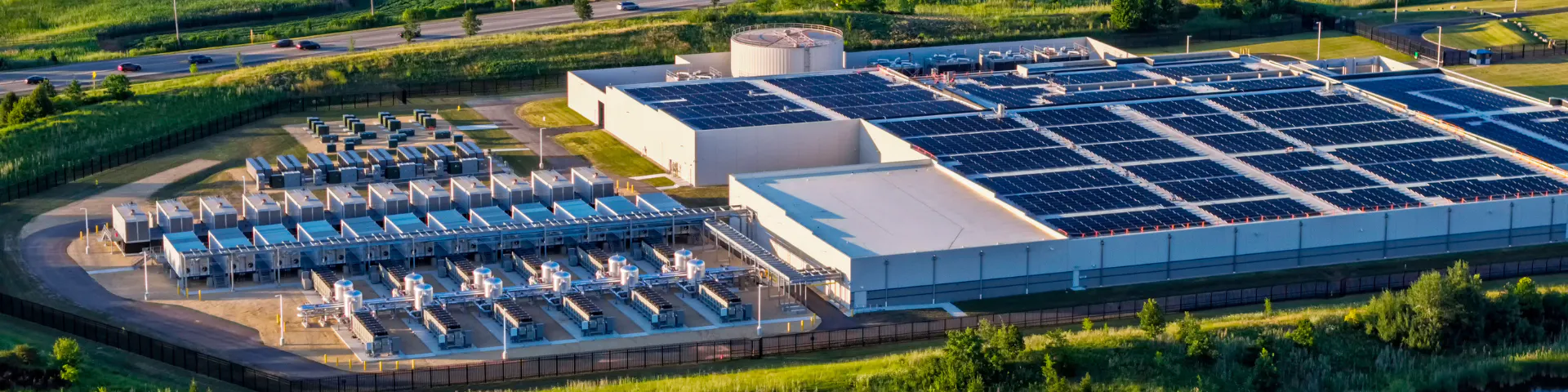
From the outside, many look like large, windowless warehouses or industrial buildings. Inside, they contain rows of server racks, extensive cabling, powerful cooling systems, backup generators, and strict security. Newer facilities can be very large (sometimes covering tens or hundreds of acres) and may include substation-level power infrastructure.
How much electricity do data centers use?
Data centers are energy-intensive because servers operate continuously and generate heat. A large facility can consume as much electricity as a small city. AI-focused data centers typically use even more power due to the specialized chips (GPUs) required for training and running AI models, which are notoriously power-hungry. As a result, operators often seek locations with reliable and affordable power supplies.
Do data centers use a lot of water?
Water consumption depends on the cooling method employed. Traditional data centers often utilize evaporative cooling, which can require significant amounts of water. However, many newer facilities, especially those designed for AI, use closed-loop liquid cooling or other water-recycling systems, resulting in much lower water usage. Water consumption varies widely depending on design, climate, and local regulations—some modern projects report water use comparable to that of a few households, while older designs can consume much more.
Are data centers noisy?
Servers and cooling systems produce constant noise, but most of it is contained within the building. External noise may originate from large cooling fans, generators (during testing or outages), or electrical equipment. Well-designed facilities and local zoning regulations typically ensure that noise levels remain within acceptable limits for nearby neighborhoods.
What about jobs and local economic impact?
The construction of a data center creates temporary construction jobs. Once operational, these facilities generally employ relatively few permanent staff (such as technicians, security personnel, and maintenance workers) given their size and cost. Economic benefits often stem more from property tax revenue, infrastructure investments, and support for local contractors than from a large, permanent workforce.
Are data centers safe?
Physically, data centers are among the most secure buildings, featuring restricted access, cameras, biometric controls, and often on-site security. Cybersecurity is also a major focus. Public concerns usually revolve around power and water demands, construction traffic, and impacts on noise or visual aesthetics, rather than safety risks to the surrounding community.
How do data centers affect nearby communities?
Common local considerations include:
Many communities negotiate agreements covering taxes, infrastructure contributions, water limits, and other conditions before approving such projects.
What’s different about AI data centers?
AI data centers are specifically optimized for training and running large AI models. They require denser clusters of specialized chips, higher power density per square foot, and more advanced cooling systems. This can result in greater electrical infrastructure needs and, in some cases, different water or noise profiles compared to traditional cloud or enterprise data centers.
Can data centers be more environmentally friendly?
Yes, operators are increasingly adopting environmentally responsible practices, including:
Water Use
What does "closed-loop cooling" data center actually mean?
Think of it like the cooling system in a car. A car doesn't dump out its coolant and refill it constantly; the same fluid loops around again and again, pulling heat away from the engine. A closed-loop data center works the same way. Water is filled into a sealed system once, then it circulates over and over to absorb heat from computer equipment, cools back down, and goes around again. It is not flushed and replaced like water in a sprinkler or a cooling tower.
How is that different from older cooling systems?
Many older industrial and cooling-tower systems work by letting water evaporate to cool things down, like sweat cooling your skin. That means they constantly need new water to replace what evaporates. A closed-loop system mostly skips that step. Because the water stays inside a sealed system, there's very little evaporation and very little water lost, so there's very little need to keep adding more.
How much new water does it need, then?
After the system's one-time initial fill, it only needs small amounts of water to “top off” or replace minor losses.
Does this system use any chemicals or create wastewater?
Because it's sealed and reused rather than run through an open system, a closed-loop design avoids the large-scale water treatment chemicals that open, evaporative systems typically require, and it doesn't discharge wastewater the way some industrial cooling processes do.
On-Site Power and Fuel Cells (Including "Bloom Cells")
Why would a data center generate its own power on-site instead of just using the grid?
Large data centers use a lot of electricity, and building or expanding transmission lines to serve them can take years. Many modern data center projects install some power generation directly on their own property — called "on-site" or "behind-the-meter" power — so the facility can meet part of its own needs without waiting on new grid capacity or competing with residential customers for power during peak hours.
What is a "Bloom cell" or fuel cell, in plain terms?
A fuel cell is a piece of equipment that turns fuel — usually natural gas, and sometimes hydrogen — directly into electricity through a chemical reaction, without burning it the way a traditional generator does. Because there's no combustion flame, fuel cells typically run quieter and cleaner than a diesel generator or gas turbine of similar size. "Bloom cell" most likely refers to Bloom Energy, a company that makes a widely used type of fuel cell (called a solid oxide fuel cell) that several large data center projects around the country have adopted for on-site power. These systems can run continuously, day and night, and are often paired with the regular power grid rather than replacing it.
Will on-site power generation create air quality or noise concerns?
On-site power generation must meet applicable federal, state, and local air quality requirements and permitting standards. The potential effects on air quality and noise depend on the type of equipment used, how it operates, and what safeguards are in place. Measures to reduce emissions and noise can help limit impacts on nearby areas.